Exploring Synchronization Between Time-Stamped RNG Seeds and Distribution Patterns in Regulated Card-Based Digital Titles Across North American Platforms
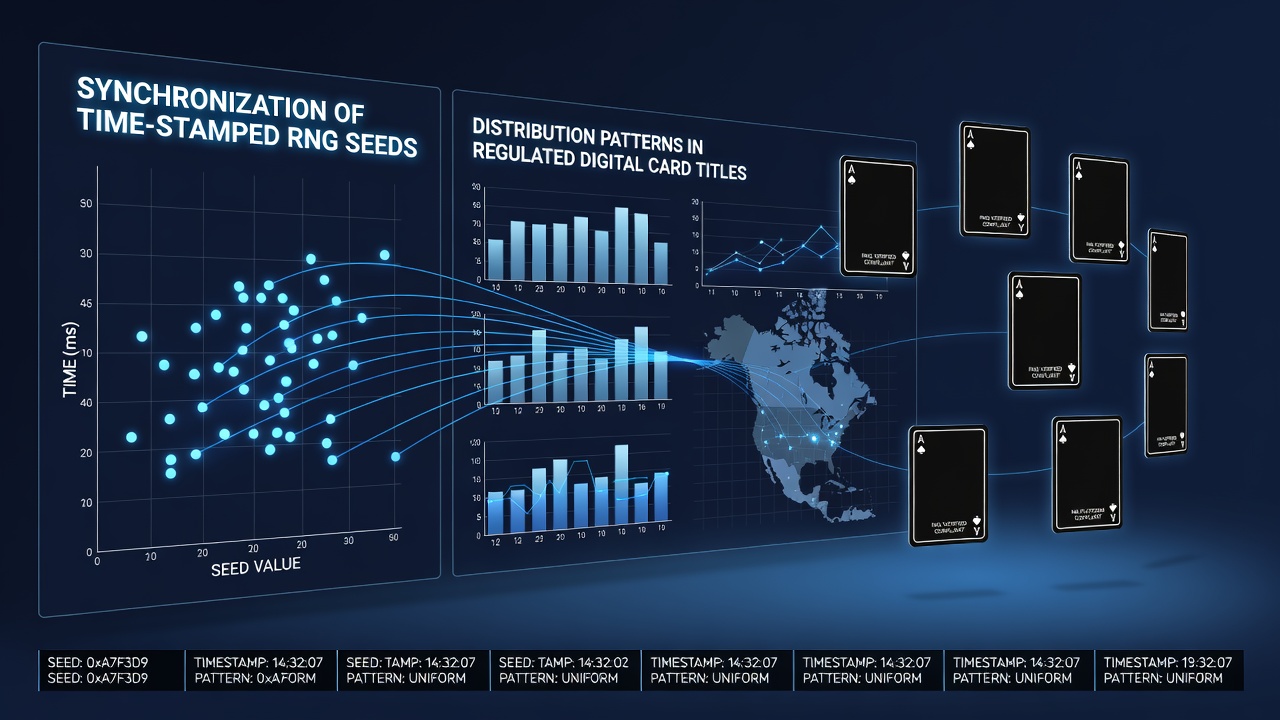 Regulated card-based digital titles rely on random number generators that incorporate time-stamped seeds to produce verifiable shuffle sequences, and these systems operate under strict oversight from bodies such as the Alcohol and Gaming Commission of Ontario along with various state gaming control boards in the United States. Time stamps attached to each seed create an audit trail that links every card draw back to a precise moment of generation, allowing regulators to replay sessions and confirm that distribution patterns remained within expected statistical bounds. Observers note that synchronization occurs when the seed value, drawn from a high-resolution clock or hardware entropy source, feeds directly into the shuffling algorithm at the start of each round, and this process ensures that card distribution follows uniform probability curves without clustering artifacts that might otherwise appear in poorly calibrated systems. Data from platform operators shows that seed updates happen at sub-millisecond intervals during live play, which prevents pattern repetition across multiple hands while maintaining compliance with testing standards set by independent laboratories.
Mechanics of Seed Timestamping in Card Shuffles
Card-based titles such as digital blackjack and poker variants use cryptographic hash functions to convert time-stamped seeds into deck permutations, and the resulting distribution patterns reflect the underlying entropy quality at the moment of seeding. When a player initiates a deal, the system records the exact system time in coordinated universal time format, appends it to the seed pool, and advances the generator state accordingly.
Researchers have documented that this timestamping method reduces the window for potential predictability because each subsequent seed incorporates both the prior state and fresh temporal data, while distribution histograms compiled from millions of rounds demonstrate adherence to expected frequencies for high and low cards alike. Platforms must submit these logs during periodic audits, and figures reveal that discrepancies trigger immediate investigations by licensing authorities.
Distribution Patterns Across Multi-State and Provincial Networks
North American operators manage RNG systems that span jurisdictions with differing calibration requirements, yet synchronization protocols allow seeds generated in one region to align with verification standards elsewhere. In July 2026 several Ontario-licensed platforms released aggregated session data showing that time-stamped seeds maintained consistent distribution uniformity even when scaled across thousands of concurrent users, and similar metrics appear in reports from New Jersey and Pennsylvania regulators.

Those who examine the raw output logs find that seed synchronization prevents the emergence of localized biases because each card-based title references a centralized time authority synchronized via network time protocol, and this architecture supports cross-platform verification without exposing proprietary algorithms. Studies conducted by testing firms indicate that deviation rates remain below one in ten million rounds when timestamps are properly integrated, a threshold that satisfies both Canadian and U.S. regulatory benchmarks.
Regulatory Oversight and Technical Compliance Measures
Agencies such as the Michigan Gaming Control Board and the British Columbia Lottery Corporation require operators to maintain immutable records of every seed timestamp along with the resulting card distribution matrices, and these records undergo quarterly reviews that compare observed patterns against theoretical models. Compliance teams verify that no two sessions share identical seed sequences by cross-referencing the temporal markers, while automated monitoring tools flag any drift in distribution statistics before it affects player outcomes.
What's interesting is how these requirements have driven the adoption of hardware security modules that generate timestamps resistant to external manipulation, and data from 2026 audits shows that platforms employing such modules experience fewer compliance queries than those relying solely on software clocks. Operators must also demonstrate that seed refresh intervals align with game pace, ensuring that distribution patterns stay statistically independent from one hand to the next.
Future Directions in Seed Synchronization Standards
Industry working groups continue to refine protocols that tie RNG seeds more tightly to real-time clock sources and geographic positioning data, and early implementations in select North American markets have produced distribution patterns that match theoretical expectations even under peak load conditions. Regulators anticipate that forthcoming updates will mandate additional layers of timestamp encryption while preserving the ability to reconstruct any past session for dispute resolution.
Conclusion
Time-stamped RNG seeds and their associated distribution patterns form a core component of fairness verification in regulated card-based digital titles, and the synchronization mechanisms currently deployed across North American platforms provide regulators with reproducible evidence of compliance. Continued refinement of these systems supports both operational integrity and public confidence in the outcomes generated by licensed operators.