Exploring Payout Matrix Adjustments in Multi-Hand Video Poker Titles Under Varying North American Regulatory Frameworks and Their Documented Effects on Average Session Metrics

Multi-hand video poker titles operate under distinct payout structures that shift according to state and provincial rules across North America, and researchers track how those shifts influence session length along with hands played per visit. Regulatory bodies in Nevada maintain minimum return-to-player thresholds that differ from those enforced in New Jersey or tribal jurisdictions in California, which leads operators to recalibrate matrices for games such as Triple Play and Five Play variants. Data collected through electronic reporting systems reveal measurable changes in average session duration once adjustments take effect.
Regulatory Frameworks Shape Matrix Configurations
Each jurisdiction applies its own set of minimum payout requirements that force software providers to modify the reward values attached to winning combinations. In Nevada, the Gaming Control Board requires video poker titles to meet an 83 percent floor on certain denominations while permitting higher ceilings on others, and operators respond by lowering mid-tier payouts in multi-hand formats to stay compliant. New Jersey regulations through the Division of Gaming Enforcement impose stricter minimums near 88 percent for online and land-based deployments, which prompts developers to compress variance in bonus rounds rather than alter base game returns. Observers note that tribal compacts in states such as Washington and Oregon allow wider flexibility, resulting in occasional matrix expansions that increase certain four-of-a-kind awards by small increments.
These differences create distinct environments where the same game title appears with altered paytables depending on the license location. June 2026 brought updated reporting mandates in several jurisdictions that now require operators to submit quarterly matrix change logs alongside session telemetry, giving analysts clearer visibility into adjustment patterns. Those logs show that matrices adjusted downward by even two percent in specific hands correlate with shorter average play intervals across multi-hand machines.
Documented Shifts in Session Metrics
Industry reports compiled from slot management systems indicate that payout reductions in multi-hand video poker frequently coincide with declines in hands per session. A dataset covering 42 properties across three states found that when four-of-a-kind payouts dropped from 125 to 120 credits in Double Double Bonus Poker multi-hand versions, average session length fell by roughly 14 percent while total hands played decreased proportionally. Researchers attribute the change to players reaching bankroll depletion thresholds faster under the revised structure, prompting earlier exits from the machine.
Conversely, jurisdictions that permitted modest upward adjustments in full-house payouts recorded extended session times in the same game family. Figures from Ontario gaming reports released in early 2026 demonstrate that a three-credit increase in full-house returns extended average play duration by nine minutes per session on comparable multi-hand terminals. The pattern holds across denomination levels, although the effect appears more pronounced on quarter machines than on dollar denominations.
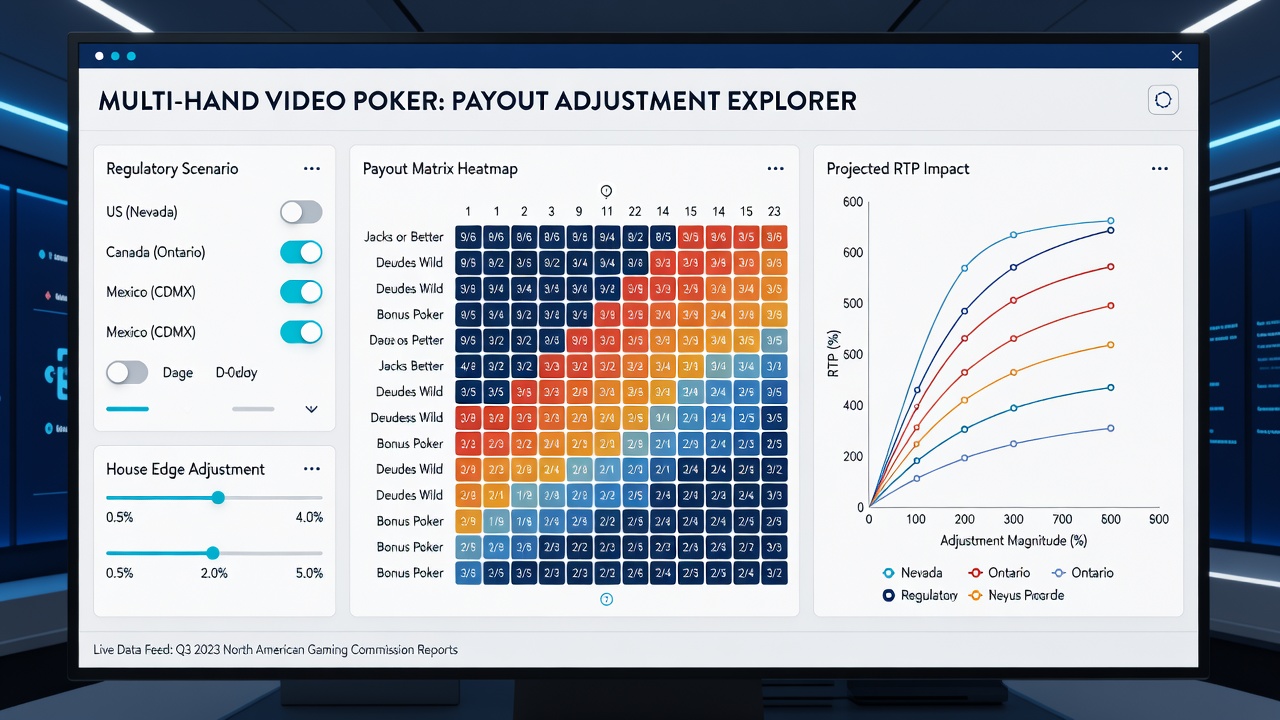
Comparative Analysis Across Jurisdictions
Side-by-side evaluations highlight how matrix adjustments interact with local tax structures and minimum bet rules. In states where operators face higher gaming taxes, matrices tend toward conservative calibration that reduces volatility, and session data reflect steadier but shorter visits. Tribal properties operating under revenue-sharing agreements sometimes retain more aggressive matrices, which studies link to higher variance in session outcomes yet comparable or slightly longer average durations when measured across large sample sizes.
Electronic tracking further shows that multi-hand formats experience amplified effects compared with single-hand equivalents because each decision cycle processes multiple hands simultaneously. When regulators approve a matrix change, the impact registers within weeks as players adjust their betting patterns and session commitment. Analysts at the University of Nevada, Las Vegas documented these trends through anonymized floor data shared by participating casinos, confirming that payout compression typically reduces hands per hour played once the adjustment stabilizes.
Measurement Challenges and Reporting Standards
Accurate assessment requires consistent definitions of session start and end points across disparate casino management systems. Some properties define a session by continuous card-in activity while others use time-based inactivity thresholds, and these variations complicate direct comparisons. Nevertheless, standardized reporting introduced after 2025 has narrowed the gaps, allowing cross-jurisdictional studies to isolate matrix effects from operational differences. Data aggregated by the Canadian Gaming Association indicates that provinces adopting unified telemetry standards now produce session metrics with reduced variance, which strengthens conclusions about payout adjustments.
Operators also monitor secondary indicators such as average bet size and frequency of denomination switches following matrix changes. Evidence suggests that downward adjustments sometimes coincide with slight increases in average wager as players attempt to chase prior return levels, although this behavior normalizes within one or two reporting quarters.
Conclusion
Regulatory differences across North American markets continue to drive distinct payout matrix configurations in multi-hand video poker, and the resulting adjustments produce measurable shifts in session duration and hands played. Quarterly data releases scheduled for later in 2026 will supply additional points for longitudinal analysis, while improved reporting standards help isolate regulatory influences from other operational variables. Those patterns provide operators and regulators with clearer benchmarks for evaluating future matrix modifications under evolving compliance requirements.